Learning designer · Bilingual English/Spanish · Sydney, working remotely
Listen. Clarify. Build.
For 19+ years I've made complex, high-stakes knowledge clear enough to learn and act on. I started in bilingual literacy classrooms. Now I design curriculum, assessment and the platforms that deliver them.
- 19+Years in education and learning design
- 2Native languages, English and Spanish
- ~55%Less time to a first draft with AI, on average
- 0AI drafts published without a person checking them
01
Listen.
Learners and the people around them know what gets in the way.
I started as a bilingual literacy educator in California, working with families, adult learners and teachers in school and community programs. That's where I learned the job: find out who the learners are, what they already know and what gets in their way. Language, literacy, time, access.
Since then I've worked on rail safety, banking certification, procurement and a school curriculum in Guatemala. The job hasn't changed. Make complex things learnable, then check that people actually learned them.
- Stories from the fieldsFor Pestisol, health workers and farmworkers told me how pesticides end up at home. Their stories went into the app, so families could see themselves in it
- Level checks that teachOn a Spanish-learning app, the opening lessons test the level learners think they're at, using survival words they can build sentences with
- One source of truthAt Allianz, procedures sat in personal notebooks. I heard each team out, then gave them one structure that drew out what they knew
02
Clarify.
Clear outcomes, in a sensible order, judged against the standard that applies.
Curriculum and assessment
Scope and sequence, outcome mapping, assessment blueprints and rubrics. I decide how learners will show they can do it before any content is written.NESA Stage 4 · Rail safety accreditation · Financial services certification · CEFR
Course design and redesign
Taking dense, accurate material and making it clear, well ordered and built around what the learner has to do next.Scenario-based learning · Articulate Storyline and Rise · Genially · Vyond · SCORM · WCAG AA
Review of AI learning content
I check AI-generated lessons, assessments and language data against written criteria, then approve, correct or reject each item. Repeated errors become rules the team can fix at the source.Two-pass review · Rubrics · Pedagogical audits
Bilingual English and Spanish
Any of the above in native Latin American Spanish, plus reviews of whether a Spanish version teaches or just translates.TESOL-certified · Localisation review · CALD and low-literacy audiences
03
Build.
Technology comes last, and a person checks everything it makes.
AI in my own production
I write the outline and the learning outcomes first. AI drafts from them, then every draft goes through a quality check and two rounds of human review before it's used. On average, that cuts the time to a first draft by about 55%, without lowering the standard.
Reviewing other teams' AI output
Teams send me AI-generated lessons, assessments and language data. I check each item against written criteria, then approve, correct or reject it. When the same error keeps coming back, I write a rule so it gets fixed at the source.
AI built into platforms
On What's Learning, AI suggests which curriculum outcomes a child's work covers. A parent approves, adjusts or rejects each one. Nothing is saved without a person's decision.
Platforms the client owns
Learning and membership platforms on LearnWorlds, Softr and Airtable that the client can run without me. For confidential material, I run AI models on my own machine instead of a cloud service.
I don't write production code. I decide what the system has to do for learning to happen.
Work
Selected work.
Who the learners were, what I designed and how we knew it worked.
-
The learners
People who want to win tenders and manage the contracts that follow. They need practical judgment, not just policy knowledge.
What I designed
- A 10-course program: 18 learning hours across 6 competency domains.
- Decision-point simulations and branching scenarios, and animated explainers such as a value-for-money module on tender evaluation.
- A shared component library and a QA gate used across every course.
How we knew
The program is still being finished, so the evidence is built into the design. Decision-point scenarios show whether learners can apply procurement principles, not just recall them. Every AI draft passes the QA gate and a two-stage human review.
- Scenario design
- Competency mapping
- Genially
- Vyond
- LearnWorlds
- AI-assisted drafting
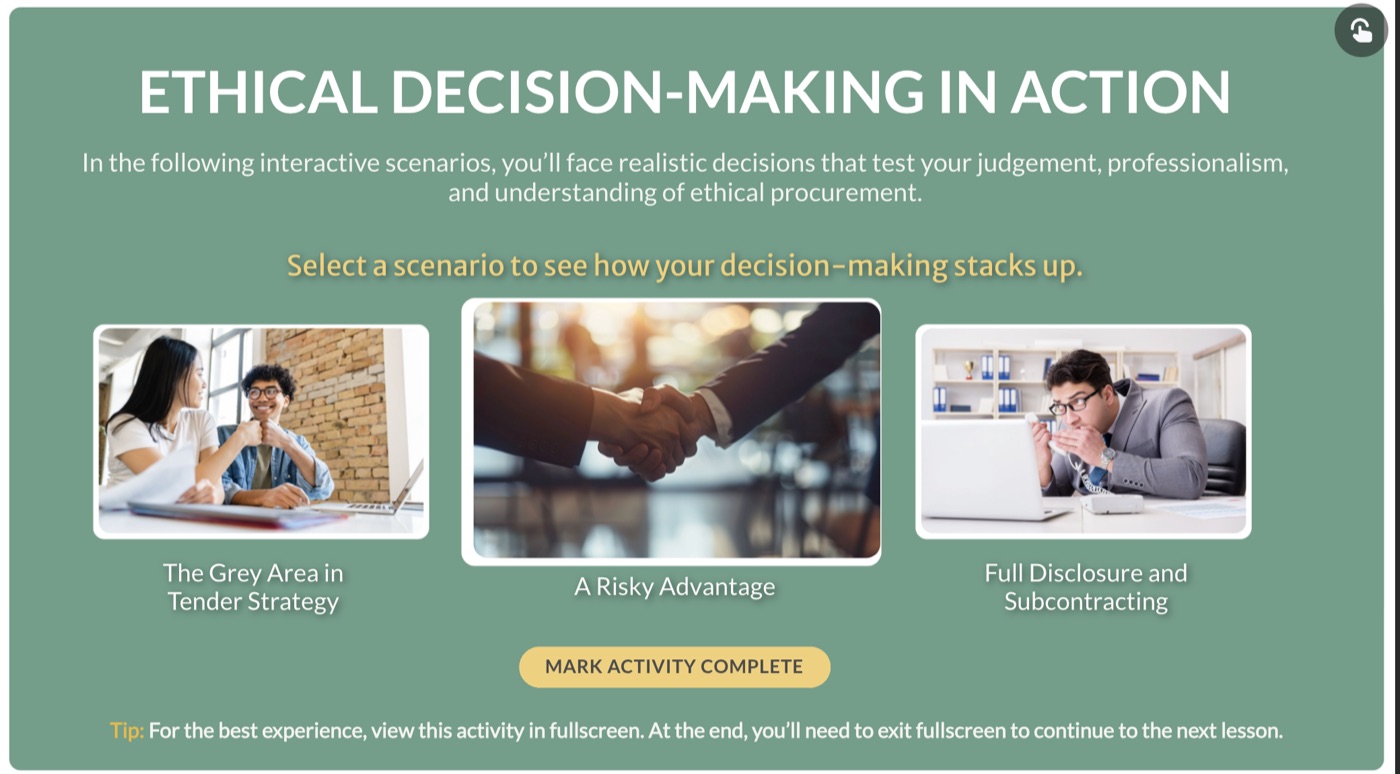
An ethical decision-making activity, from an earlier version of the Procurement Principles course. -
The learners
NSW homeschooling families with children in Stage 4 (Years 7–8), on Standard or Life Skills pathways. Parents need to show which curriculum outcomes their child's work covers.
What I designed
- 179 NESA outcomes across 7 subjects, for both pathways.
- AI suggests the outcomes a piece of work matches, and a parent approves, adjusts or rejects each one.
- Each family's data kept separate.
How we knew
Shipped in April 2026 and in beta with NSW homeschooling families. The parent-approval step is itself the evidence design: nothing is saved to a child's record without a person's decision.
- Curriculum mapping
- NESA
- Claude API
- Airtable
- Softr
-
The learners
Spanish-speaking farmworker families, many with limited literacy and patchy data access, reached through community health workers. They needed practical ways to prevent pesticide exposure at work and at home.
What I designed
- A topic menu of illustrated cards: pesticides, protection, illness, first aid, labels, protective equipment, rights and the environment.
- Plain-language Spanish, translated from English source material so families with limited literacy could follow it.
- Offline-first, syncing only when a secure connection is available.
- Rewards and progress that collect no personal data, to protect workers' privacy.
How we knew
Co-designed with community health workers and changed in response to their feedback. Prototypes were tested with users from different cultures before launch. The app launched on the App Store and Google Play, and has since been retired.
- Health literacy
- Plain-language Spanish
- Low-literacy UX
- Offline-first
- Privacy
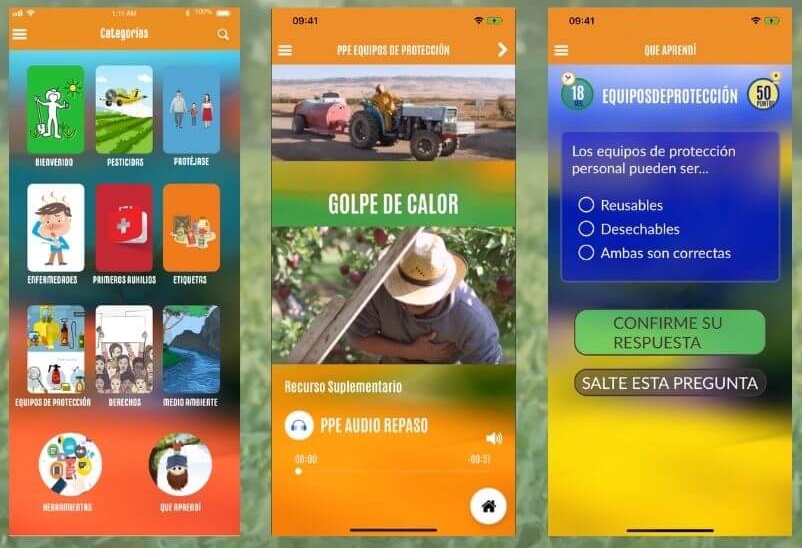
Three screens in Spanish: the topic menu, a lesson on heat stroke and a quiz on protective equipment. -
The learners
English-speaking adult beginners learning neutral Latin American Spanish (CEFR A1–A2) for travel and everyday situations.
What I did
- A three-round review of about 5,000 vocabulary rows, the lesson previews and the beta app, working with the founder and engineers.
- Two separate passes: accuracy first, then teaching value.
- Survival vocabulary first, and a fixed opening block of courtesy and survival words.
How we knew
The engineers confirmed my findings, including errors in phonetic transcriptions and Spain-only verb forms in the Latin American version, and fixed them at the source. They adopted my opening block across the 116-lesson beginner sequence.
- AI output review
- Spanish linguistics
- CEFR
- Learning design
-
The learners
Staff across three business units, working from procedures scattered across thousands of documents. They needed one reliable place to find the right procedure.
What I designed
- SOPs, written for staff, and videos of common processes.
- The structure for a single SharePoint procedures library, and the plan to migrate 2,400+ documents into it.
- Access levels for each department, agreed with that department.
- Support for a new governance framework for learning resources.
How I worked
I managed stakeholders to set priorities, followed up with SMEs using a RACI and managed project resources.
- SharePoint
- Knowledge management
- Technical writing
- SOP governance
-
Who it serves
People living rural, expat or in-between lives, who join by invitation to find and contact others like them.
What I built
- Signup, profiles, a member directory and manual approval, with consent captured at signup.
- Private one-to-one messaging, with all data owned by the client.
- Branded email from the client's own domain, and a French version that keeps member-written content out of translation.
- Reviewed message access rules and closed a gap, so each member can only see their own conversations.
How we know it works
Launched in three phases, with a handover document at each stage. The client keeps commissioning new phases.
- Softr
- Airtable
- Resend
- Weglot
- Privacy and consent
An amazingly positive and solution-focused approach to complex tasks… dedicated, reliable, methodical and very capable.
A highly skilled and dedicated professional. He is always willing to help out other teams when needed.
About
The person behind the work.
Teacher, designer and founder, working in English and Spanish across South America, the US and Australia.

I’m Juan, a learning designer from Patagonia who grew up in California and now lives in Sydney. I’ve lived and worked across South America, the US and Australia, I work fluently in English and Spanish, and I’m used to working across time zones.
I started out in bilingual, intercultural education in California and southern Chile. That’s where I learned what still drives my work: people learn when they feel connected and things are made clear, not just when topics are covered and training is delivered. Since then I’ve worked across schools, community programs, corporate training and regulated industries like rail safety and finance.
Before Duvanced I ran Koalingo, a translation, localisation and digital learning company, for five years. Today I co-own Tender Mastery and take on curriculum, assessment and platform work through Duvanced.
Outside work, you’ll find me cooking, watching movies or on a basketball court somewhere with my son.